
Riley County Court Records After Arrest
The Riley County arrest-to-court path usually starts with arrest by RCPD or another law-enforcement agency, booking into Riley County Jail, an opportunity to address bond after booking, a first appearance, and prosecutor review. The court record is not the same thing as the jail booking record. The jail can confirm current custody, bond, and jail charge information, while the court file shows the charge or charges filed in a case and how those charges move through hearings and disposition.
The Riley County Attorney's Office prosecutes criminal and traffic offenses that occur in Riley County, except city ordinance violations, which are typically handled by Manhattan Municipal Court. For current custody and booking detail, use Riley County jail inmate records. For booking-photo questions, use the Riley County jail mugshots page. Court records after a jail arrest are the charge and case side of the same event.
Find Riley County Court Records
For district court cases, Kansas CaseSearch is the main public web path. The Kansas Judicial Branch district court records page explains public access to district court records, and Kansas CaseSearch is the public portal for searching case information and documents. The portal can be used when a Riley County jail arrest has become a filed district court case.
- Open Kansas CaseSearch and choose a search path that matches the information available.
- Search by defendant party name if no case number is known.
- Use a case number, citation, business name, or attorney search when those details are known.
- Open the case result and compare the charge list with jail or bond information.
- Check hearing entries, warrant entries, disposition, and document access limits before treating the case as complete.
The Kansas CaseSearch portal shows the statewide court-search entry point used for Riley County district court cases.
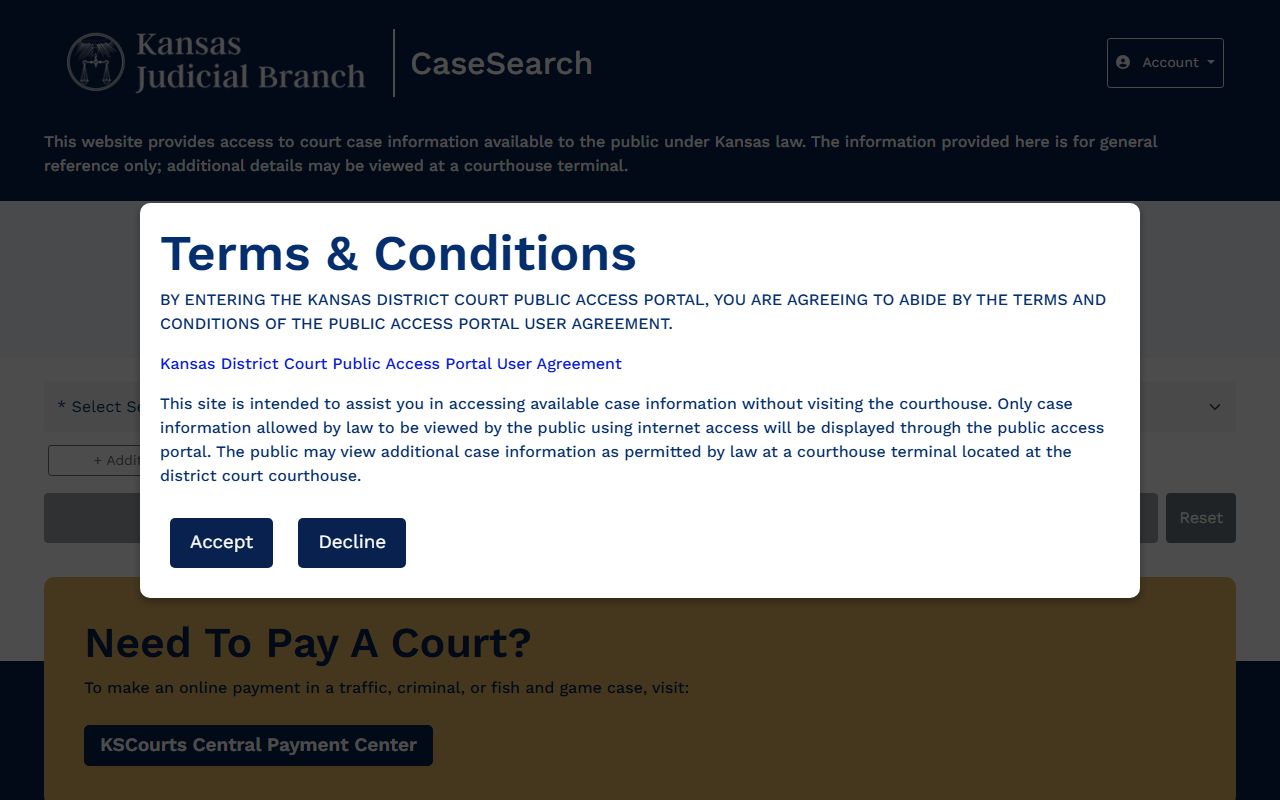
When a record is not available through the portal, Kansas courts state that each courthouse has a computer reserved for public searches of court case information and records.
Riley County CaseSearch Fields
Kansas CaseSearch does not depend on a jail roster number. It is a court-record search, so case identifiers, party names, citations, and attorney details matter more than jail housing or custody status. Search spelling matters, and a newly arrested person may not appear until the prosecutor files the case and the court record is created.
| Field Label | Type | Required | Options / Format Notes |
|---|---|---|---|
| Case number | Text | Optional search path | Use when known from citation, complaint, court notice, or clerk paperwork. |
| Party name | Text | Optional search path | Search the defendant by name; spelling and initials may affect results. |
| Business name | Text | Optional search path | Used for organizational parties. |
| Citation | Text | Optional search path | Useful for traffic and some municipal or ordinance-related matters. |
| Attorney | Text | Optional search path | Search by attorney information when supported by the portal. |
Riley County First Appearance
First appearance is the first court event after a jail arrest. It is not the trial. It is where the court addresses the early case status, bond conditions, and scheduling. Riley County research lists district court first appearances on Monday, Wednesday, and Friday at 1:30 PM at 100 Courthouse Plaza in Manhattan. Municipal or city court first appearances are listed for Tuesday and Thursday at 8:00 AM at 610 Colorado Street in Manhattan.
Those two schedules show why court records after arrest must be routed by jurisdiction. A district criminal case belongs with Riley County District Court. City ordinance matters usually belong in Manhattan Municipal Court. If custody is the question, the jail remains the right first call. If filed charges, hearing times, or disposition are the question, court records and court staff are the more accurate path.
The official Riley County District Court page gives the court location, clerk, administrator, and public hours.
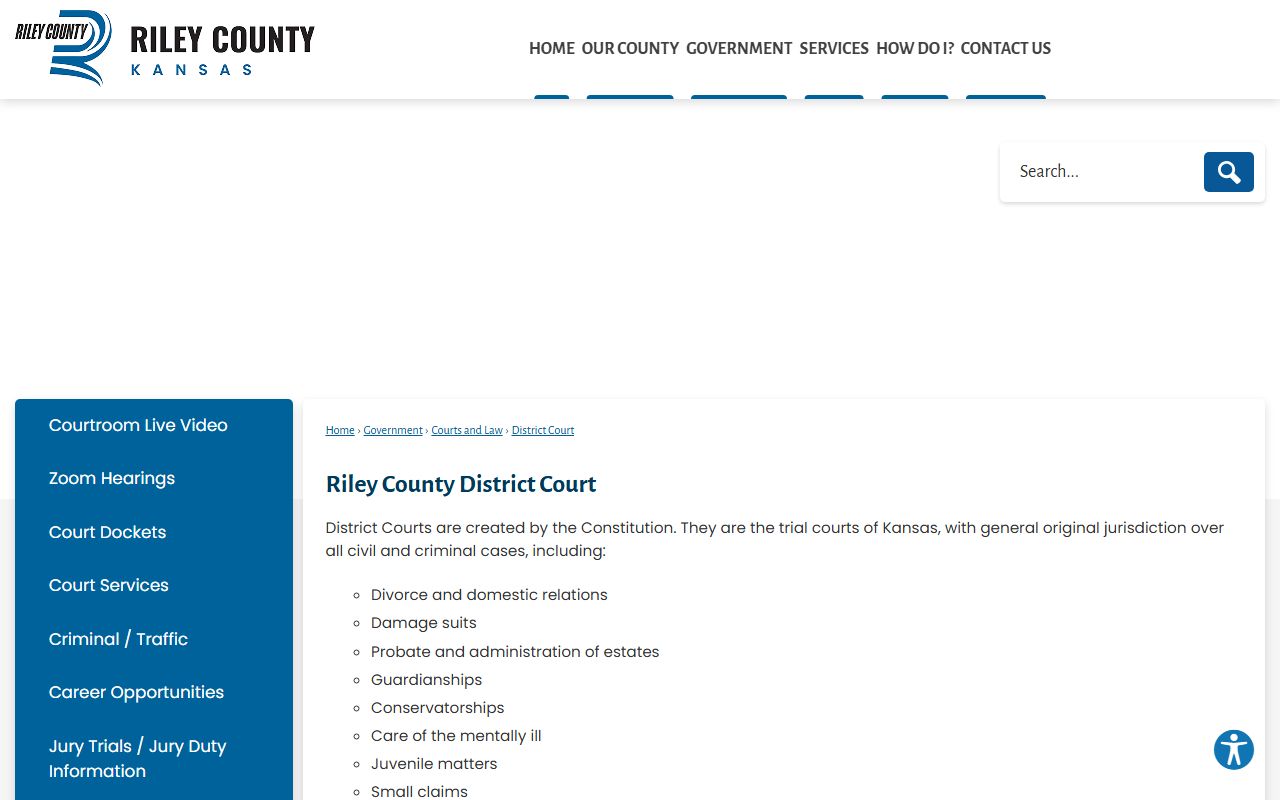
Use the district court contact when CaseSearch does not show the needed court record or when an in-courthouse terminal search is required.
Riley County Attorney Role
The Riley County Attorney is Barry Wilkerson. The office is at 105 Courthouse Plaza, Manhattan, KS 66502, phone 785-537-6390, and is open Monday through Friday from 8:00 AM to 5:00 PM. The Riley County Attorney page states that the office handles criminal prosecution, traffic offenses, Child in Need of Care matters, and involuntary commitments. It also works with RCPD, Kansas Highway Patrol, Kansas State University Police, KBI, and several federal agencies.
The County Attorney's role is key because jail charges can differ from filed court charges. The County Attorney FAQ says a victim does not file or drop charges. That decision belongs to the County Attorney's Office. A booking entry may reflect what a person was arrested for, while the court case reflects what the prosecutor filed, amended, dismissed, or resolved.
The official Riley County Attorney page ties the prosecution office to the Riley County charge-filing process.
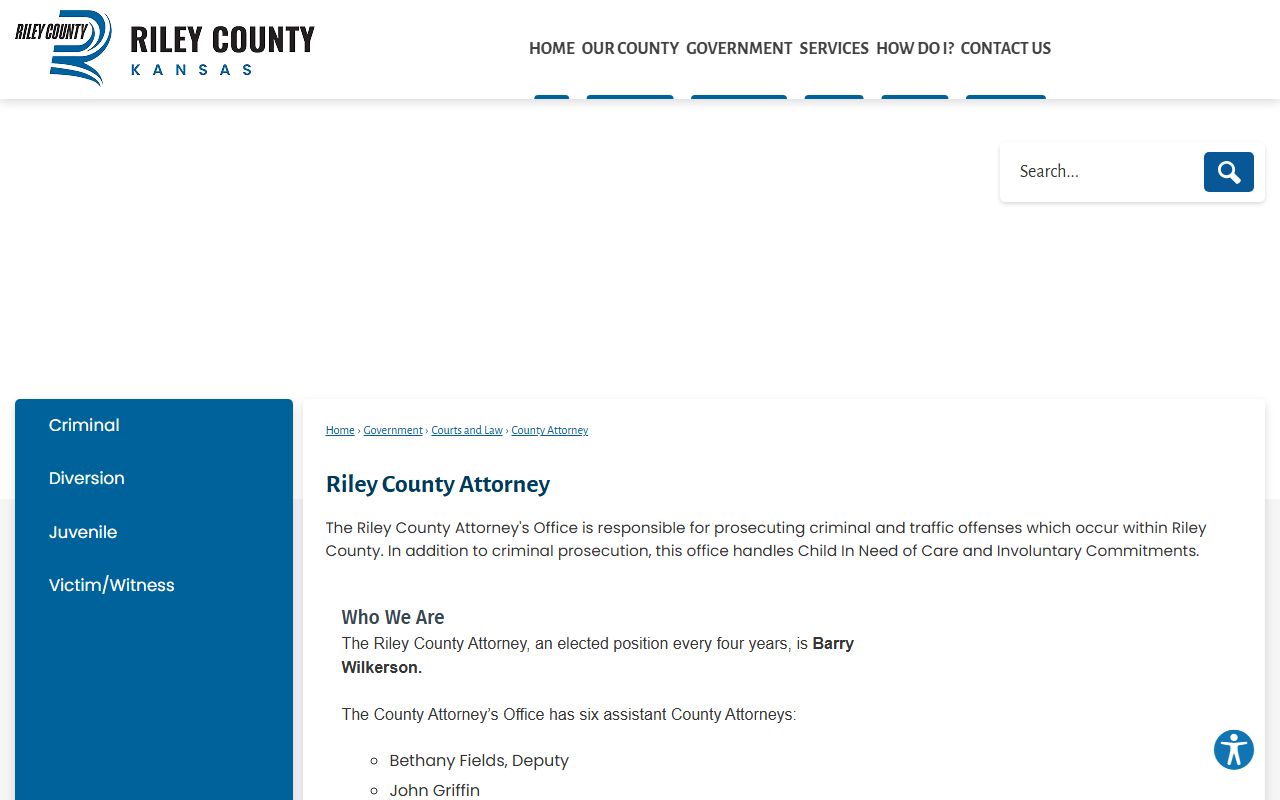
The prosecutor contact is not a shortcut for checking custody. It is the office tied to filed charges, victim-witness questions, and prosecution decisions.
Riley County Charging Documents
Court records after a jail arrest begin to take shape through charging documents. Kansas practice can involve a complaint, an information, or an indictment, depending on the case path. The exact document in a Riley County case should be checked through the court record, the clerk, or counsel. The point for record search is simple: the charging document is the bridge between arrest and the court case.
| Document | Who Uses It | What It Does | Search Note |
|---|---|---|---|
| Complaint | Often officer or prosecutor initiated | States the alleged offense and can start the criminal case. | May be the first filed charge document after arrest. |
| Information | Prosecutor | Formally charges offenses after review. | Common in felony prosecution paths. |
| Indictment | Grand jury | Charges offenses through grand jury action. | Less common, but still a charging path. |
Riley County Charge Status
Charge status can change after arrest. A jail arrest may begin with one listed charge, but the court record may later show amended, reduced, added, dismissed, or resolved charges. That is why a court-record search should not rely only on the earliest jail information. The current court status is the better source for what is pending or final.
| Status | What It Means | Why It Matters |
|---|---|---|
| Pending | The charge has been filed and has not reached final disposition. | Future hearings or plea negotiations may still change the case. |
| Amended | The filed charge or details were changed by the prosecutor or court process. | The amended charge may differ from the original booking charge. |
| Reduced | The charge level or offense was lowered. | It may affect bond, plea terms, sentencing, and record interpretation. |
| Dismissed | The charge was ended without conviction on that count. | A dismissal is not the same as an expungement. |
| Disposed | The court has entered an outcome. | Read the disposition before calling a charge a conviction. |
Bond After Riley County Arrest
Bond starts on the custody side but often appears in court records after a jail arrest. RCPD says an arrested person is given a bond amount and may pay exact cash in full or select a bonding agent. Jail staff cannot recommend a bonding agent. After full booking, the inmate receives multiple phone calls to try to bond out, and if that does not happen, the person is placed in housing until seeing a judge or bonding out.
| Bond Type | How It Works in the Riley Research |
|---|---|
| Exact cash bond | RCPD says the full exact cash amount can be used. |
| Surety bond | The inmate selects a bonding agent; jail staff do not recommend one. |
| Personal recognizance | Not specifically described by the local jail page; a judge may set release conditions. |
| No-bond or hold | Not specifically described locally; verify with the jail or court when release is blocked. |
| Other-agency detainer | A separate agency hold can affect release even if local bond is addressed. |
Riley County Arrest Warrants
Warrants often connect jail arrest records and court records. RCPD publishes an official active warrants page with a linked PDF list, but the page warns that the list should not be used as confirmation that a warrant is still active. The warrants section can be reached at 785-537-2112 ext. 1904. Crime Stoppers at 785-539-7777 is listed for information about a person with an active warrant.
RCPD also says a person can turn themselves in at RCPD day or night. It warns the public not to attempt to detain a person believed to have a warrant and not to pay a fine online until contacting RCPD or the respective court. The County Attorney FAQ adds another limit: the County Attorney's Office will not reveal whether an arrest warrant has been issued.
| Warrant Channel | Record Type | Use With Care Because |
|---|---|---|
| RCPD active warrants PDF | Public list | Freshness is not guaranteed by the page text. |
| Warrant phone inquiry | Official contact | Call 785-537-2112 ext. 1904 for warrant questions. |
| District or municipal court | Case follow-up | Court routing depends on whether the matter is district or city court. |
Charges vs Convictions
A charge is an accusation in a court case. A conviction is an outcome after a guilty plea, verdict, or other qualifying disposition. Riley County court records after a jail arrest may show charges long before any conviction exists. That difference is crucial for case research, background checks, and plain reading of a docket.
| Point | Charge | Conviction |
|---|---|---|
| Stage | Filed allegation after arrest or review. | Final case outcome on an offense. |
| Meaning | Not proof that the person committed the offense. | Reflects plea, verdict, or qualifying judgment. |
| Record search | May appear early in CaseSearch or court filings. | Should be confirmed through disposition or criminal history. |
| Change risk | Can be amended, reduced, added, or dismissed. | Can still be affected by appeal, expungement, or later order. |
Sealed vs Expunged Records
Kansas access law starts from a policy that public records are open, but the Kansas Open Records Act also includes exemptions. Court access is also shaped by Kansas Supreme Court Rule 22 for public electronic district court case records. Expungement laws are separate from ordinary case searching. K.S.A. 22-2410 addresses expungement of arrest records, and K.S.A. 21-6614 addresses expungement of certain convictions, arrest records, and diversion agreements.
| Point | Sealed | Expunged |
|---|---|---|
| Basic effect | Public access is restricted by law or court rule. | Eligible records are limited through an expungement order. |
| Public view | May be hidden from ordinary public access. | May not appear in the same way as an open case record. |
| Agency access | Some agencies may retain lawful access. | Lawful exceptions can still apply under Kansas law. |
| How to confirm | Check with the court clerk or legal counsel. | Review the actual expungement order and statute. |
Note: A dismissed charge can still appear in records unless a rule, statute, or court order limits access.
KBI Criminal History Records
The Kansas Bureau of Investigation criminal history search is a statewide, fee-based criminal-history channel. It is not a substitute for reading the Riley County court file because it has different release rules and record categories. KBI instructions describe released and nonreleased records, fingerprint options, and access through KanAccess. Research also notes that the service is available from 4:00 AM to midnight Central.
RCPD local background checks are narrower. The Riley County research lists a $10 local-only background check through RCPD, while RCPD notes that people who lived elsewhere in Kansas may need the statewide KBI check. For court records after arrest, the best practice is to compare the court case, local records, and statewide criminal history only when each source is relevant to the question being asked.
Riley County Court Contacts
Use the office that holds the specific record. The district court clerk is the route for district court case records, courthouse terminal access, and clerk questions. The County Attorney handles prosecution decisions and victim-witness routing. The jail remains the source for current custody, bond, and jail charge information.
Riley County District Court
100 Courthouse Plaza
Manhattan, KS 66502
785-537-6364
Monday-Friday, 8:00 AM-5:00 PM
Riley County Attorney
105 Courthouse Plaza
Manhattan, KS 66502
785-537-6390
Monday-Friday, 8:00 AM-5:00 PM
Manhattan Municipal Court
610 Colorado Street
Manhattan, KS 66502
785-587-2450
City and ordinance matters